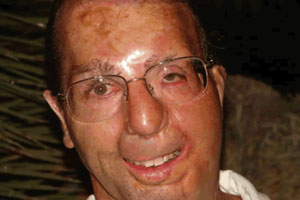
Burn Survivors Who Inspire

Norma_Bravo_-_drumming.jpg
Norma Bravo suffered burns on over 80% of her body.

Burns Can't Beat This Drummer

Norma Bravo jams to the emotional sounds of alternative rock band The Strokes as they belt out her favorite song, "Last Nite."

Their music penetrates deep wounds with lyrics such as "Oh, baby, I don't care no more; I know this for sure; I'm walking out that door."

Yes. Teen angst is common for just about any young woman. But for Bravo, the pain is much more real.

In 2007, the Mexico City native was burned over 80% of her body during a gas explosion at her home. At the time of the accident, Bravo was 17 years old.

After extensive treatments - both physical and mental - at Shriners Hospital for Children-Galveston in Texas, Bravo must now cope with the devastating reality that the hospital has closed its doors. Shriners had the only children's burn center in Texas.

"That was like a second home to me," Bravo said. "You can feel really comfortable in there. No one watches you like you're different."

The hospital, which closed after severe damage from Hurricane Ike in September, has announced that it no longer plans to reopen for reasons that are still unclear.

Officials claim the closure is a result of a financial shortfall. Rumors abound, however, that the hospital is not reopening at the request of other Shriners hospitals that want to absorb some 5,000 patients treated at the Galveston location.

Bravo will now be receiving treatment at a Shriners hospital in Houston, which does not have a burn unit.

After the fire, Bravo worked hard to recover by playing drums at the Shriners music therapy program led by therapist Christine Neugebauer.

"Norma was really into music, but she was very limited on what she could do," Neugebauer said. "It was a really big motivator for her. Norma is an incredibly creative person. For her, it's been such an important outlet to get through her injuries."

Bravo's mother gave Norma a drum set for her eighteenth birthday. Sadly, the cherished drums were destroyed during the hurricane.

But Neugebauer was determined to find a way for Bravo to keep on drumming. She came upon the Burn Advocates Network, a non-profit organization that raises funds for survivors of catastrophic burns. With help from Sam Davis, the organization's founding director, Bravo received a new set of drums.

"I got in touch with Sam Davis and told him her story," Neugebauer said. "She's such a unique case."

The Burn Advocates Network has been instrumental in raising awareness for burn survivors and, more importantly, providing resources for them to attend burn camps throughout the country.

Burn camps offer children with major burn scars and often damaged hands the opportunity to participate in music groups via adaptive musical instruments.

According to Davis, BAN's mission for burn survivors is to develop an outlet to rebuild their self-esteem as they face the challenges of reintegration into society.

"Over the past three years we developed the first music program adapted to the abilities of children who have physical challenges associated with severe burn injuries," Davis said. "Just because a kid's hands or arms are badly damaged does not mean they can't learn to play an instrument.

"We found a stringed instrument that we introduced to camps and burn centers around the country. All it really took was a wooden pick holder to adapt it to someone who can't hold the thing on their own. We have watched amputees pick up our Strumsticks and really play songs along with their fiends. For many it has been the first time in their lives they ever played an instrument."

The Burn Advocates Network recently supplied a dozen Strumsticks to recuperating soldiers at Brooke Army Medical Center in San Antonio. BAMC treats soldiers who have suffered severe burns while serving in Iraq and Afghanistan among other locations.

"We were introduced to Norma as we were developing our Drum Circle for burn camps. We are assembling a variety of hand percussion instruments like Djembes and shakers, bells, and maracas," Davis said.

"Having 20 kids with scars jamming with percussion instruments really builds a sense of community quickly," Davis said. "We have several burn survivor drummers who are volunteers for us and give back to the burn community. When we heard about Norma, we knew that she was the happy ending separated only by a replacement drum kit. One of our supporters, The Memphis Drum Shop, helped us to make her dream come true, or at least end a nightmare."

On March 31 in Israel, BAN will be opening the first specialized camp for children with burn scars, situated at a kibbutz on the shores of the Sea of Galilee. It will be open to Jewish, Christian and Muslim children who are recovering from devastating burn trauma.

BAN also organized the first Burned Veterans Rally deploying 50 Hydrobikes - specialized water bikes - with veterans and Purple Heart recipients, burn survivors, and volunteers circumnavigating the Statue of Liberty.


Norma_Bravo_-_before_burn.jpg

Norma Bravo before her tragic accident.


Bravo hopes to make a difference for burn survivors through her music. She and Neugebauer along with other music therapists performed at the Galveston hospital before it closed.

Bravo enjoyed playing songs that struck a chord with others in similar situations, such as "Scar Tissue" by the Red Hot Chili Peppers, Nirvana's "Come As You Are," and her favorite Strokes tune.

It's no wonder that Bravo finds that these songs speak to her in ways most people can never imagine.

For Bravo, playing drums and making music gets her through the emotionally painful times when curious - albeit insensitive - people ask her, "Oh my God, what happened to you?"

Amid the never-ending stares and whispers, Bravo takes a deep breath and leans on her drums to keep her standing tall.

In her tragic world, the lyrics tell it all, "And people, they don't understand; your girlfriends, they can't understand . . . on top of this, I ain't ever gonna understand."

_____________________________________________________________________
Sam___BAMC_guy.jpg
BAN Founding Director Sam Davis and Staff Sgt. Christopher Edwards.

On the Road to Recovery

Kicking back in his Toyota Camry Hybrid, 37-year-old Staff Sgt. Christopher Edwards slowly turns the key in the ignition as he readies to take his first drive in exactly 4 years and 4 days.

Gently pressing the gas pedal, Edwards eases out of the driveway as he begins his journey to Brooke Army Medical Center in San Antonio.

But this journey to the hospital is just one stop on a difficult road to recovery.

In 2006, Edwards was injured by a roadside bomb while serving in the U.S. Army in Bagdhad. Edwards suffered burns on almost 80 percent of his body.

"My goal is to be as independent as possible," Edwards said. "I had to get back in the swing of things. Walking is still painful. I'm learning how to cook with adaptive equipment. I'm gettin' there. It's hard because you're using muscles in ways you haven't before. You have to adjust."

And on this road to independence, driving played an important role. Edwards now drives to BAMC for his burn treatments while living with the excruciating pain of his wounds.

Both hands suffered extensive damage including partial loss of several digits. For Edwards, driving is no small task.

"I'm a little nervous," Edwards said. "I've only got one eye I can use. I'm still kind of nervous about the whole deal. My vision is bad, and I use special adaptive equipment for the wheel.

"I've got my right hand but my fingers don't move. My left hand has the pinky, the rest of my fingers are cut off at the first knuckle."

Despite once again driving, many other once simple, mundane tasks are still tremendous challenges. Known as activities of daily living, or ADLs, basic undertakings such as eating and dressing often cause unimaginable pain.

"I still want to be able to do ADLs everything from making iced tea to coffee," Edwards said. "Some things go well and some things we're still working on. What you used to do normally isn't remotely close to what you can do now."

With his wife Tammy always by his side either physically or emotionally, Edwards knows he could not have come this far without her support.

"She's really been the rock that's kept me going," he said. "She's had to do almost everything for me. For stuff around the house, I'm limited as to what I can do. She's picked up the slack on everything because of my limitations."

Edwards says his son Riley, who was just over three-years-old at the time of the accident, has come to terms with the injuries his father has endured.

"There's more playing I can do now," Edwards said. "Horsing around, stuff like that. It's still tough. I still can't go out and play soccer with him."

And while the emotional pain of not being able to always play with his son hurts, Edwards doesn't let it get him down.

On his trips to BAMC, Edwards says he makes every effort to talk to the other burn survivors and help lift their spirits.

"I talk to the guys at the hospital everyday," he said. "I tell them that if I can survive so can they."

Edwards knows that simple human encouragement - through support groups and burn assistance organizations - makes all the difference to a successful recovery.

Burn camps, for example, offer children with major burn scars and often critically damaged hands the opportunity to participate in music groups via adaptive musical instruments.

"The biggest thing is that it teaches them there's life after the burns," Edwards said. "There's still stuff they can do. There are things they can contribute to and have fun with."

Edwards hopes to one day volunteer at burn camps for children. Until then, he will continue to encourage burn survivors at BAMC as he travels back and forth for treatments.

"Everything you do you have to adapt to your new limitations," he said. "Everything hurts. But some days are better than others."

His journey may not be over, but for Edwards it's been a successful road to recovery so far.